
From “Potentially Divisive” to Prohibited: The Coast Guard’s Swastika Policy Flip and the Shadow of Normalization
In a whirlwind of controversy that unfolded over mere hours on November 20, 2025, the U.S. Coast Guard—under the Trump administration’s Department of Homeland Security—briefly appeared to soften its stance on Nazi swastikas and lynching nooses, reclassifying them as “potentially divisive” symbols rather than outright emblems of hate. The proposed shift, detailed in an updated civil rights manual set to take effect December 1, sparked immediate outrage from lawmakers, Jewish advocacy groups, and civil rights organizations, who decried it as a dangerous normalization of bigotry amid rising antisemitism. By late Thursday, the service backtracked, issuing a firmer policy explicitly banning “divisive or hate symbols” like swastikas and nooses in all Coast Guard facilities and assets. Yet the episode exposes deeper tensions in the Trump administration’s approach to diversity, extremism, and military culture, raising uncomfortable echoes of 1930s Nazi Germany’s deliberate mainstreaming of hate symbols—and the catastrophic harms that followed.
The Policy’s Rocky Path – From Strict Bans to a Brief Downgrade
The Coast Guard’s original policy, established in 2019 under the Biden administration, unequivocally labeled swastikas, nooses, and Confederate flags as symbols “widely identified with oppression or hatred,” classifying their display as a “potential hate incident” requiring immediate investigation and potential removal if they undermined unit morale or discipline. This aligned with broader military guidelines across the armed services, emphasizing zero tolerance for hate in a force increasingly diverse, with over 40% of recruits identifying as racial or ethnic minorities. Private spaces like family housing were exempt, but public displays were strictly curtailed to foster cohesion.
The controversy ignited in mid-November 2025 when an internal draft of the 2025 civil rights manual leaked to media outlets like The Washington Post. The revisions, proposed by acting Commandant Adm. Kevin Lunday, shifted the language: Symbols like swastikas and nooses would be deemed “potentially divisive” rather than hate emblems, with incidents reframed as “reports of harassment” only if an aggrieved individual came forward. Commanders could still order removals after legal consultation, but the 45-day reporting window—down from an unlimited timeframe—drew sharp criticism, especially for personnel at sea who might face prolonged exposure to such symbols without safe recourse. The policy also quietly removed gender identity as a “protected characteristic,” aligning with Trump’s January 2025 executive order banning transgender service members.
Public backlash erupted instantly. Democratic Sens. Jacky Rosen (D-Nev.) and Chuck Schumer (D-N.Y.) condemned the changes as a rollback that endangered Jewish and Black service members amid surging hate crimes. Rosen warned it “puts their safety at risk,” while Schumer called it “disgusting” encouragement of extremism. Jewish leaders like Menachem Rosensaft, a Holocaust scholar, equated it to dismissing KKK hoods as mere debate fodder. The Southern Poverty Law Center labeled it a “national embarrassment,” arguing it created a hostile environment for minorities. Even anonymous Coast Guard officials voiced fears: “If you’re at sea… stuck with [a swastika] for 60 days, are you going to feel safe?”
By evening, the service capitulated, releasing a memo titled “Prohibition of Divisive or Hate Symbols and Flags.” It reinstated explicit bans: “Divisive or hate symbols and flags are prohibited,” listing swastikas, nooses, and hate-group emblems as prime examples, effective immediately across all workplaces, vessels, and assets. Lunday affirmed: “Any display… will be thoroughly investigated and severely punished.” The reversal was hailed by critics like Rep. Lauren Underwood (D-Ill.), who credited her office’s intervention, but it left lingering questions about the initial intent.
Trump’s Hand: DEI Purges and the Push for “Readiness” Over Rights
The policy’s genesis traces directly to the Trump administration’s Day One overhaul of federal institutions. On January 20, 2025, President Trump fired Commandant Linda Fagan—the first woman to lead a U.S. military branch—for her “excessive focus” on diversity, equity, and inclusion (DEI) initiatives, including sexual assault prevention and extremism training. Fagan’s replacement, Lunday, suspended the old harassment policy within days, aligning with Defense Secretary Pete Hegseth’s September directive to review military anti-hazing and bullying rules as “overly broad,” arguing they sapped “readiness.” Hegseth, a Fox News alum and Trump loyalist, has paused DEI trainings across services, including the Coast Guard, framing them as “woke distractions.”
This fits Trump’s broader “America First” agenda, which views DEI as divisive and prioritizes “warrior ethos” over inclusivity. The administration has vowed “forceful steps” against antisemitism—often code for curbing campus protests over Gaza—but critics see hypocrisy in softening military hate policies while purging transgender protections. Homeland Security Secretary Kristi Noem, overseeing the Coast Guard, has echoed this, praising the revisions as streamlining for “mission focus.” The brief downgrade, insiders say, stemmed from efforts to mirror other services’ “neutral” language, but the outcry forced a retreat—highlighting how public pressure can still check executive overreach.
Echoes of the 1930s – When Symbols of Hate Became State-Sanctioned
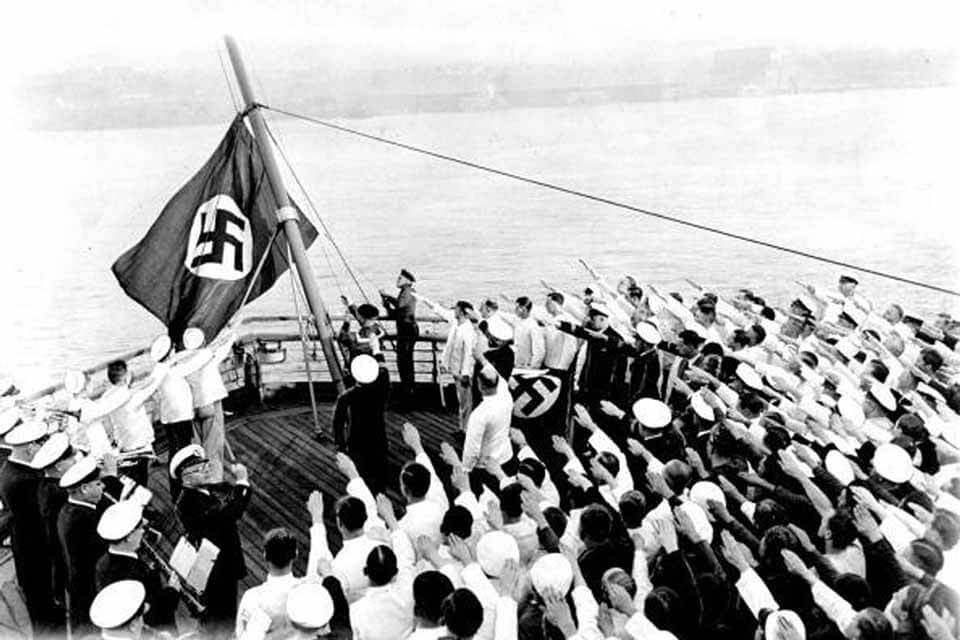
The Coast Guard saga evokes haunting parallels to 1930s Nazi Germany, where Adolf Hitler’s regime methodically normalized hate symbols to erode societal norms and embolden extremism. The swastika, an ancient emblem of good fortune in Hindu, Buddhist, and even early 20th-century Western cultures (used by U.S. Army units in World War I and on RAF planes until 1939), was hijacked by the Nazis in 1920 as the party’s flag—a black hooked cross on red, symbolizing “Aryan purity.” By 1933, after Hitler’s chancellorship, it became Germany’s co-national flag (sole by 1935), plastered on uniforms, buildings, and rallies—transforming a fringe far-right icon into state orthodoxy.
This normalization wasn’t accidental: Propaganda Minister Joseph Goebbels flooded media with swastika imagery, framing it as patriotic while demonizing Jews as “vermin.” It desensitized the public, making antisemitic violence routine—from 1933 boycotts to Kristallnacht pogroms in 1938—paving the way for the Holocaust’s genocide of six million Jews. The regime’s “German Greeting” (Heil Hitler salute with swastika armband) ritualized allegiance, suppressing dissent through fear. As historian James Skidmore notes, this perversion “twisted [the swastika] into the graphic embodiment of intolerance,” enabling racial laws like the 1935 Nuremberg decrees that stripped Jewish rights.
Today’s brief Coast Guard pivot—downgrading symbols of genocide and lynching (over 4,000 Black Americans terrorized by nooses post-Civil War)—mirrors this early desensitization. Just as Nazis co-opted the swastika for “national pride,” the Trump-era draft risked framing hate as “debate,” potentially emboldening extremists in uniform, much like the SA Brownshirts who paraded swastikas to intimidate foes in 1933.
Division, Recruitment Woes, and a Slippery Slope to Extremism – The Harms Ahead:
Even with the reversal, the damage lingers. The initial proposal signaled tolerance for ambiguity, potentially chilling reports of hate—especially in isolated settings like Coast Guard cutters, where a 45-day window could trap victims with perpetrators. Civil rights experts warn this erodes trust, mirroring Nazi Germany’s early 1930s climate where normalized symbols fostered “self-censorship” among Jews and leftists, spiking assaults by 400% post-1933. For the Coast Guard, already facing recruitment shortfalls (down 15% in 2025 amid DEI cuts), it risks alienating minorities, who comprise 25% of personnel and report hate incidents at twice the rate of white service members.
Broader effects could cascade: A perceived green light for “divisive” displays might embolden far-right groups within the ranks, as seen in the military’s post-January 6 extremism surge (over 100 veterans charged). In 1930s Germany, swastika ubiquity normalized pogroms, leading to 91 Jewish deaths on Kristallnacht alone; today, it could heighten risks for Jewish, Black, and LGBTQ+ troops, with antisemitic incidents up 140% in the U.S. since 2023. As the ADL notes, such symbols “permanently convert… into a symbol of hate,” amplifying trauma for survivors’ descendants.
The Coast Guard’s quick about-face shows accountability works, but it underscores a precarious moment: In an administration prioritizing “readiness” over rights, how many more “divisive” lines will blur before hate becomes policy? History’s lesson is clear—normalization starts small, but its harms are irreversible. Vigilance, not ambiguity, guards our democracy.